
General Contractor: Repair or Replace? How Anaheim Homeowners Decide
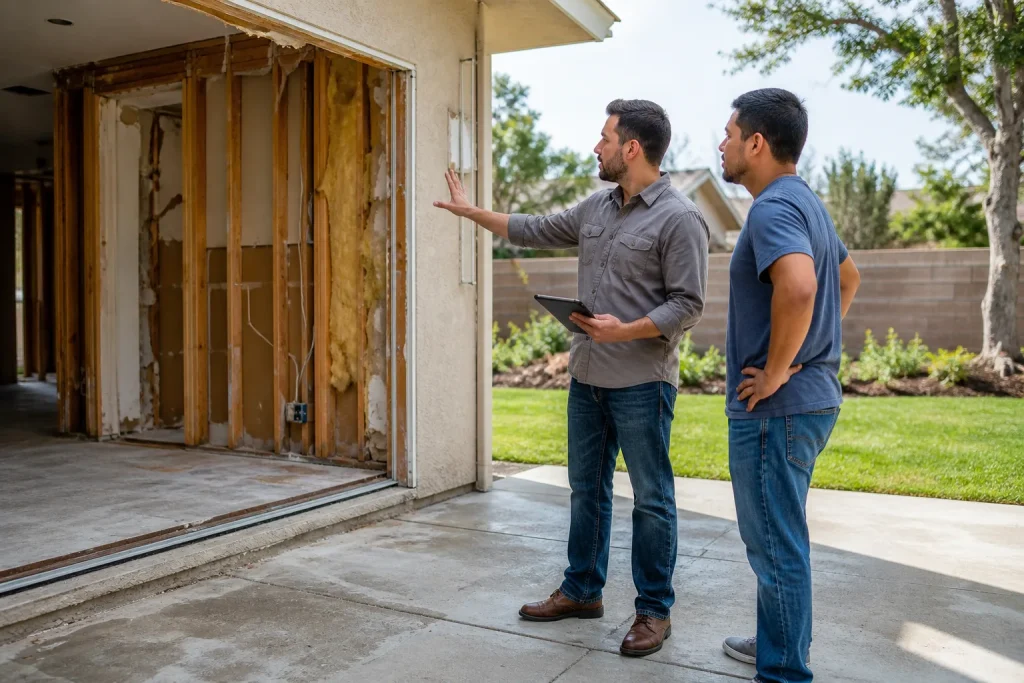
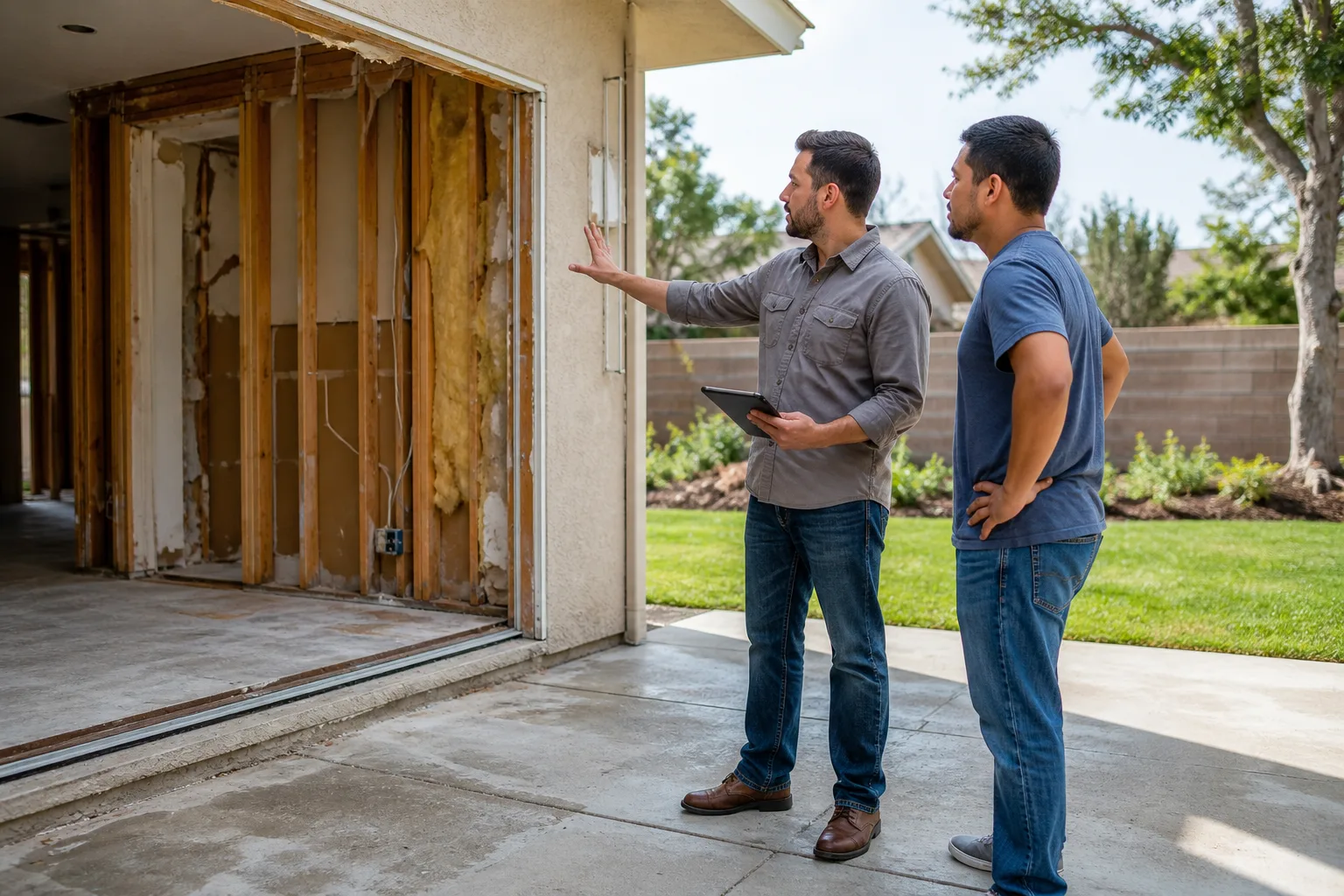
Most repair-or-replace decisions in Anaheim aren’t really about age, and they’re not about looks. They’re about whether the structure underneath the damage can hold a new repair without failing again within two years. A $400 stucco patch that hides $6,000 of water-damaged sheathing is the classic version of this mistake, and we see it on a steady basis across the city. Getting the call right the first time is what this guide is for.
If you’d rather have a contractor walk your project and put the answer in writing, call (844) 320-2908. Free estimates, no pressure to decide on the spot.
Key Takeaways
- Check the substrate (the material under the visible damage) before you price anything.
- When a repair costs 40-50% or more of replacement, replacement usually wins over a five-year window.
- Anaheim’s heat cycling and dry-then-wet rainy seasons make patched failures predictable.
- A written scope is your protection against a verbally quoted repair that turns into a mid-job upgrade.
What is the substrate test, and why does it decide most repairs?

The substrate test asks one question before any price gets quoted: is the material beneath the visible damage still sound enough to anchor a fix? If the answer is no, the repair is a temporary patch on a problem that will return. A contractor who skips this step and quotes you from the curb isn’t being lazy exactly; they’re just taking a shortcut that costs you later.
Here’s how a proper inspection works in practice. We probe the substrate, not just the finish: tap on tile to hear hollow spots, press a screwdriver into exposed framing, check moisture at the base of walls, and look for the tell-tale bubbling that means water is trapped in a wall cavity. For stucco, that means checking the lath and sheathing behind the crack. For a subfloor, it means checking for soft spots and any sign the plywood has delaminated.
One example we ran into recently, a hallway closet repair over in West Anaheim: the visible damage was a 4-inch patch of cracked drywall on the ceiling. The substrate test found a slow roof leak that had been feeding moisture into the joists for months. The “repair” quote went from $300 to $2,400 once the picture was clear. Not a fun call to make, but a lot better than discovering it after the third patch fails.
What is the 40-50% rule, and how does it work in Anaheim?
When repair cost exceeds roughly 40-50% of replacement cost, replacement typically wins on a five-year horizon. The math is straightforward once you frame it that way. A repair that costs half of replacement usually buys you three to five years before the next failure; replacement gives you fifteen to twenty-five.
Anaheim adds a wrinkle. Our dry summer and early-fall heat cycling expands and contracts exterior materials hard, then our rainy season sends water into every crack that opened up. A patch that would last a decade in a milder climate might last five years here. So the 40-50% range leans slightly toward replacement on anything exposed to weather, and slightly toward repair on interior items that haven’t been fighting the sun.
Here’s a rough framework for the numbers we commonly see in Anaheim:
| Item | Repair range | Replacement range | Typical call |
|---|---|---|---|
| Stucco patch (small, no sheathing damage) | $400-$900 | $3,000-$7,000 full wall re-stucco | Repair, if substrate is sound |
| Stucco patch with sheathing damage | $1,800-$4,500 | $3,000-$7,000 | Replace – repair exceeds 50% |
| Interior framing (single stud, no rot) | $600-$1,400 | $4,000-$9,000 partial wall rebuild | Repair |
| Subfloor replacement (single room) | $900-$2,000 patch | $4,500-$8,500 full room | Replace if rot or delamination |
These are honest ranges for Anaheim, not a quote for your specific project. The number that matters is what a contractor finds when they open it up.
Why do Anaheim’s climate conditions accelerate certain failures?

Anaheim sits in a climate that’s hard on exterior materials in a specific way: long dry stretches followed by sudden, heavy rain. When the ground and the exterior surfaces are dry, they shrink. When the first real storm hits, water finds every hairline crack the dry season opened. Then the sun comes back and the cycle repeats.
Three materials feel this most in Anaheim:
- Stucco and housewrap. Hairline cracks in stucco are normal; water intrusion isn’t. Once water gets past the stucco, the paper-backed housewrap and sheathing can sponge up moisture and hold it against the framing.
- Subfloor and joist ends. Bathroom and laundry-room leaks that dry out between uses are easy to miss until the subfloor has already delaminated. Knocking on a floor to hear a hollow or soft spot is a fast diagnostic.
- Wood trim and door frames. South- and west-facing wood trim gets the worst of the sun, then swells in the first rain. Paint failure on a south-facing frame is a five-year warning sign, not a cosmetic issue.
If your exterior is showing cracks along a sun-facing wall, that’s worth a closer look before the first rain. We’ve seen plenty of Anaheim homes where a $400 stucco patch turned into four figures of sheathing work because the crack got “patched” without checking what was behind it.
Why does a written scope matter so much on repair-or-replace jobs?
A verbal scope lets a contractor pivot mid-job: they find a problem during demo and suddenly the “repair” quote becomes a “since we’re in there” upgrade with no number attached. That’s how a $900 repair becomes a $4,200 invoice. It’s not always dishonest, but it’s always expensive and never what you agreed to.
A written scope does three things:
- Pins down what’s being repaired – the exact area, materials, and finish so there’s no ambiguity about where the work stops.
- Defines the “if we find X, then Y” branch up front – so if a stud is rotted behind the wall, you know the change-order price before they cut the drywall.
- Triggers the written guarantee – the 365-Day Done Right Promise is tied to the scope, so the contractor comes back and fixes any failure at no charge if the repair doesn’t hold.
We include a written price on every Penhallow Remodeling project before any work starts, and that includes repair jobs. If a repair fails inside the guarantee period, we come back at no charge. If a repair fails later, the free return visit covers the inspection so you know what happened.
Related services in Anaheim: for whole-project planning, see our General Contractor in Anaheim page.
What does “repair vs. replace” look like across Anaheim’s real-world cases?

Three examples cover most of what we see. The numbers are real ranges, not floor pricing.
Case 1: Cracked stucco on a sun-facing wall
A homeowner in the Colony area called about a spider-web crack above their front window. The visible stucco damage was small. The substrate test found the housewrap behind it had failed, and two studs were showing surface rot. The repair-only path ($500) would have looked great on paper but failed within two rainy seasons. The full path – stucco, housewrap, sheathing, and framing – landed around $4,000. The honest answer was replacement of that wall section, not a patch.
Case 2: Interior framing after a bathroom leak
This is the most common mid-job surprise in Anaheim: a bathroom leak quietly softens the studs behind the tile. If the scope is “replace the drywall and drywall screw,” the contractor finds soft framing mid-job and the price balloons. If the scope says “if framing is soft when opened, line-item price is $X per linear foot,” you know what you’re getting into before the first tile comes off. The 40-50% rule applies here cleanly: if the framing repair costs more than half of a partial rebuild, the rebuild usually makes more sense.
Case 3: Aging subfloor near the laundry
The first sign of a failing subfloor is often a tile that cracks in the same spot twice. In the Anaheim Hills area, we’ve seen a “patch” (about $900) turn into a full-room replacement ($5,000-$7,000) once the plywood proved to be delaminated rather than just stained. A moisture meter and a screwdriver probe take five minutes and answer the question.
When should you call a pro?
Call before the visible damage gets patched. A trained eye with a moisture meter, a probe, and twenty minutes can answer the repair-or-replace question in a way that costs $0 up front and thousands less over the next five years. Some things – a stucco crack that’s only in the finish, a single cracked tile on sound substrate – really are a small repair. The judgment call is which is which, and that’s where we’d rather you ask than guess.
If your project touches the Kitchen Remodeling in Anaheim or Bathroom Remodeling in Anaheim scope, we can also give you the full-project view of how a repair plugs into a larger plan.
The Bottom Line
Repair or replace is a substrate question first, a cost-ratio question second. If the structure behind the damage is sound, a repair is often the right call; if it’s not, patching the surface just delays the more expensive version of the same job. Anaheim’s heat-and-rain cycles make the wrong call fail faster here than in a milder climate. Get the substrate checked, get a written scope, and run the 40-50% math. That’s the framework that keeps you out of the repeat-repair trap.
If you’re in Anaheim and need help deciding, Penhallow Remodeling offers free estimates – call (844) 320-2908 to schedule one. You can also review our Penhallow Remodeling Anaheim home page for how we handle pricing and guarantees on every job.
Frequently Asked Questions
Repair stucco if the substrate (housewrap and sheathing) is sound and the damage is surface-level. Replace the affected wall section if the substrate test shows water intrusion, soft sheathing, or rot, because a surface patch will fail again within two rainy seasons. Anaheim’s dry-then-wet climate accelerates this; a $400 patch can hide $4,000 of sheathing damage. Call (844) 320-2908 for a written repair-or-replace scope before deciding.
The decision itself is usually free if bundled with a written estimate. The repair you avoid tends to be the more expensive outcome: a $400 patch that fails typically leads to a $3,000-$7,000 replacement that was preventable. Replacement costs for full wall re-stucco range from $3,000-$7,000; interior framing rebuilds run $4,000-$9,000; subfloor replacements run $4,500-$8,500. Call (844) 320-2908 for an exact number on your project.
Most surface-level repairs don’t require a permit. Structural replacement, wall re-framing, or any work that changes the building envelope does. The written scope will state exactly which permits apply before work starts. Never let a contractor tell you a permit “isn’t needed” on anything structural – that’s a red flag. Call (844) 320-2908 and we’ll tell you what triggers a permit for your specific project.
A well-executed repair on sound substrate typically lasts eight to fifteen years before major attention is needed. A repair that ignores substrate problems fails in two to five years – often within two rainy seasons if it’s on an exterior wall. The difference is almost entirely about whether the substrate is sound at the time of the repair. Call (844) 320-2908 for a substrate check before you commit to a fix.
Written by the team at Penhallow Remodeling Anaheim.
Need Construction Help?
Call Penhallow Remodeling Anaheim - licensed & insured, here with fast after-hours help in Anaheim.
(844) 320-2908